
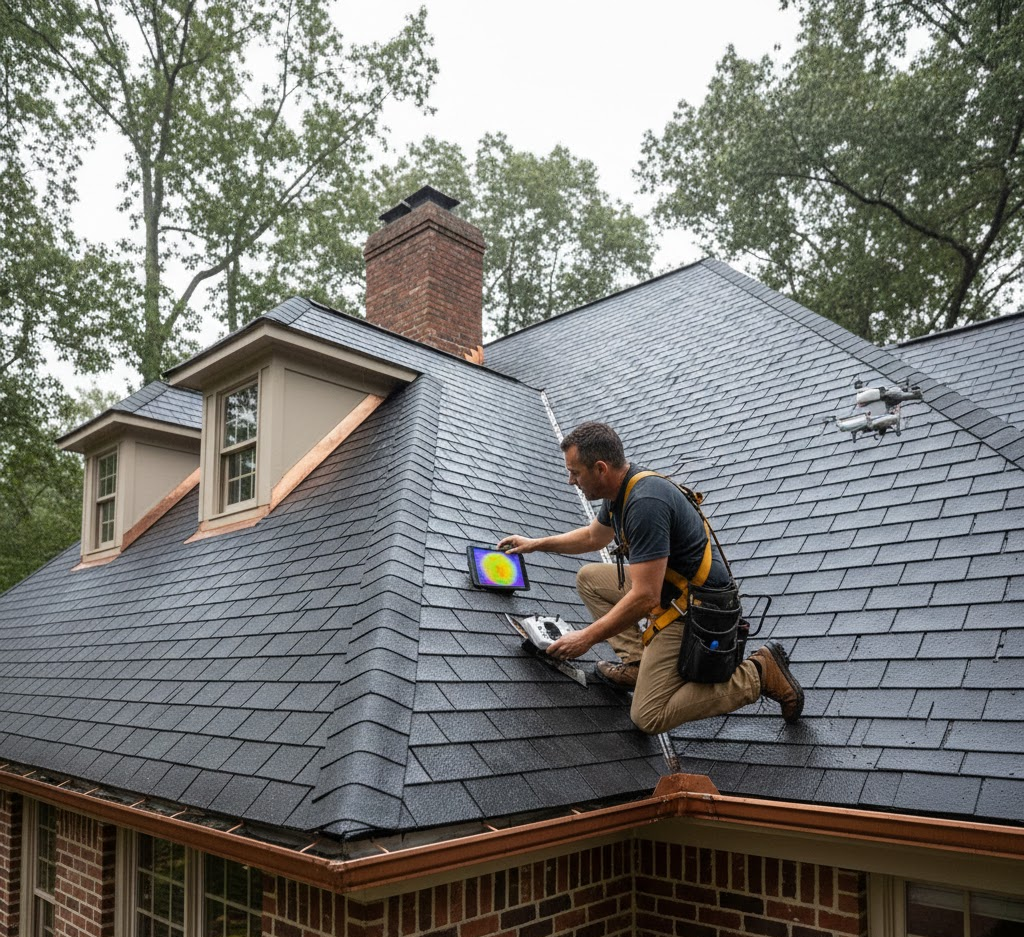
The integrity of a building is often judged by its foundation, but its survival is dictated by its crown. For property owners, the realization that a roof is failing rarely comes during a gentle spring breeze; it arrives in the middle of a torrential downpour or following a heavy, wet snowfall that puts thousands of pounds of stress on the structural decking. When moisture breaches the primary barrier of a home or commercial facility, the clock starts ticking on a series of chemical and structural reactions that can compromise the safety and value of the entire asset.
Navigating the world of roofing repairs requires more than just a ladder and a hammer. It requires an understanding of how localized weather patterns, material science, and architectural design converge. At Rembrandt Roofing & Restoration, we view every repair as a technical challenge that demands a permanent solution rather than a temporary patch. In the following exploration, we will dive deep into the mechanics of roof failure, the economic logic of timely intervention, and the professional standards that separate a lasting repair from a recurring headache.
The Hidden Catalyst: Why Small Issues Become Catastrophic
It is a common misconception among property owners that a roof leak is a singular event. In reality, a leak is the final symptom of a long-term process of degradation. Most roofing repairs are necessitated by the slow erosion of defensive layers that go unnoticed for years.
The Dynamics of Wind Uplift
Wind does not just blow across a roof; it creates pressure differentials. As wind hits the face of a building and travels upward, it creates a vacuum effect on the leeward side and over the ridge. This “uplift” can subtly loosen fasteners and break the thermal seal between shingles. Once that seal is broken, the shingles flutter, allowing wind-driven rain to be pushed upward—counter-intuitively—underneath the overlapping layers. Professional repair strategies must account for these pressure zones, ensuring that perimeter edges and ridges are reinforced to withstand localized gust patterns.
Thermal Cycling and Material Fatigue
Every day, a roof undergoes an invisible transformation. In the heat of a 2026 summer afternoon, asphalt and metal components expand. As the sun sets and temperatures drop, they contract. This constant movement, known as thermal cycling, places immense stress on the areas where different materials meet, such as where a chimney’s brickwork meets the roofing substrate. Over time, sealants become brittle and flashing pulls away from the wall. A sophisticated approach to roofing repairs involves using high-elongation sealants and mechanical counter-flashing that can move with the building without snapping the moisture seal.
Anatomical Focus: The Critical Points of Failure
To understand the necessity of expert intervention, one must look at the “choke points” of a roofing system. These are the areas where water is naturally funneled and where the risk of penetration is highest.
Valley Integrity and Debris Management
Valleys are the high-traffic highways of a roof. They collect water from two different planes and direct it toward the gutters. Because of this volume, any imperfection in the valley lining—whether it is an “open” metal valley or a “closed” shingle valley—will lead to rapid water ingress. Furthermore, in areas with significant tree cover, valleys often collect organic debris. This debris traps moisture against the shingles, leading to granular loss and eventually rotting the underlayment. Effective roofing repairs often involve stripping these valleys back to the deck to install ice and water shields that provide a secondary, self-healing waterproof barrier.
The Complexity of Penetrations
Every hole cut into a roof for a vent pipe, attic fan, or skylight is a potential liability. The gaskets around plumbing boots are often made of neoprene or rubber, materials that have a shorter lifespan than the shingles themselves. Cracked boots are a leading cause of “mystery leaks” that appear in bathrooms or kitchens. Replacing these components is a standard part of maintenance, but it must be done with precision to ensure the new flashing integrates seamlessly with the existing shingle courses.
The Economic Argument for Proactive Repair
From a facility management or homeowner perspective, the primary deterrent to seeking roofing repairs is often the perceived cost. However, a data-driven look at property maintenance reveals that deferred maintenance is the most expensive path a property owner can take.
Preserving the Insulation R-Value
The roof and the attic work together as a thermal envelope. When a leak occurs, the attic insulation—whether fiberglass batts or blown-in cellulose—absorbs the moisture. Once insulation becomes wet, it loses its R-value (resistance to heat flow). This means that even a small leak can lead to a significant increase in monthly utility bills as the HVAC system struggles to compensate for the lost thermal barrier. By the time the water stains appear on the ceiling, the owner has often already paid for the repair several times over in wasted energy costs.
Avoiding the “Replacement Trap”
A well-maintained roof can often last 25 to 30 years, depending on the material. However, a roof that is neglected often requires a full replacement by year 15. The goal of professional roofing repairs is to extend the service life of the existing system. By spending a fraction of the cost of a new roof on targeted repairs and maintenance, owners can defer a capital expenditure of tens of thousands of dollars, allowing for better cash flow management and property appreciation.
Technical Standards in Modern Restoration
At Rembrandt Roofing & Restoration, we adhere to a standard of repair that mirrors the original installation’s engineering requirements. A “patch” is not a repair if it does not address the underlying physics of the roof.
Decking Inspection and Remediation
When a section of shingles is removed for repair, the exposed wooden deck tells a story. If the wood is discolored, “spongy,” or shows signs of delamination, it must be replaced. Nailing new shingles into compromised wood is a violation of building codes and a recipe for future failure, as the fasteners will not have the pull-out resistance required to hold the shingles during a wind event.
Matching Material Specifications
A common issue in the industry is the use of mismatched materials. Using a 3-tab shingle to repair an architectural laminate roof—or vice-versa—creates an uneven surface that disrupts the natural flow of water. Furthermore, matching the color and style is not just an aesthetic concern; it is about ensuring the thickness of the materials aligns so that the “lap” of the shingles remains watertight.
Environmental Factors and Regional Challenges
Every geographic location presents a unique set of challenges for a roofing system. In regions prone to high humidity, the growth of Gloeocapsa magma (the bacteria that causes black streaks) can eat away at the limestone filler in shingles, weakening them over time. In colder climates, the primary enemy is the ice dam.
The Ice Dam Cycle
Ice dams occur when heat escapes from the house into the attic, melting the snow on the roof. As the meltwater runs down to the cold eaves, it refreezes, creating a dam of ice. Subsequent meltwater pools behind this dam and is forced under the shingles. Professional roofing repairs in these environments must include an evaluation of attic ventilation and insulation to address the root cause, rather than just fixing the shingles that were damaged by the ice.
The Role of Professional Documentation in 2026
In the current real estate and insurance landscape, the value of a property is closely tied to its maintenance records. When Rembrandt Roofing & Restoration performs roofing repairs, we provide the documentation necessary to protect the owner’s investment.
- Insurance Compliance: Many insurance carriers are becoming more stringent about the age and condition of roofs. Documented professional repairs can prevent a policy from being canceled or a claim from being denied due to “negligence.”
- Resale Value: A home inspector’s report that identifies a “past leak” can derail a property sale. However, a report that shows a “professionally repaired and certified roof” provides peace of mind to buyers and keeps the closing on track.
Safety and Liability: The Risk of the Amateur Approach
Roofing is consistently ranked as one of the most dangerous professions. For a property owner, the liability of an uninsured or untrained individual performing roofing repairs on their property is a significant risk. Beyond the physical danger, an improper repair can void the manufacturer’s warranty on the roofing materials. Most major shingle manufacturers require that repairs be performed according to specific technical bulletins to maintain the validity of the long-term warranty.
Conclusion: Restoring Confidence in Your Shelter
A roof is more than a line item on a maintenance checklist; it is the silent protector of everything you value. From the family memories housed within a home to the expensive inventory stored within a warehouse, everything depends on the integrity of that overhead barrier.
Choosing a partner for your roofing repairs means choosing a team that understands the gravity of that responsibility. At Rembrandt Roofing & Restoration, we combine technical mastery with a commitment to transparency. We don’t just fix leaks; we restore the structural harmony of your property, ensuring that when the next storm rolls in, your only concern is staying dry inside.